

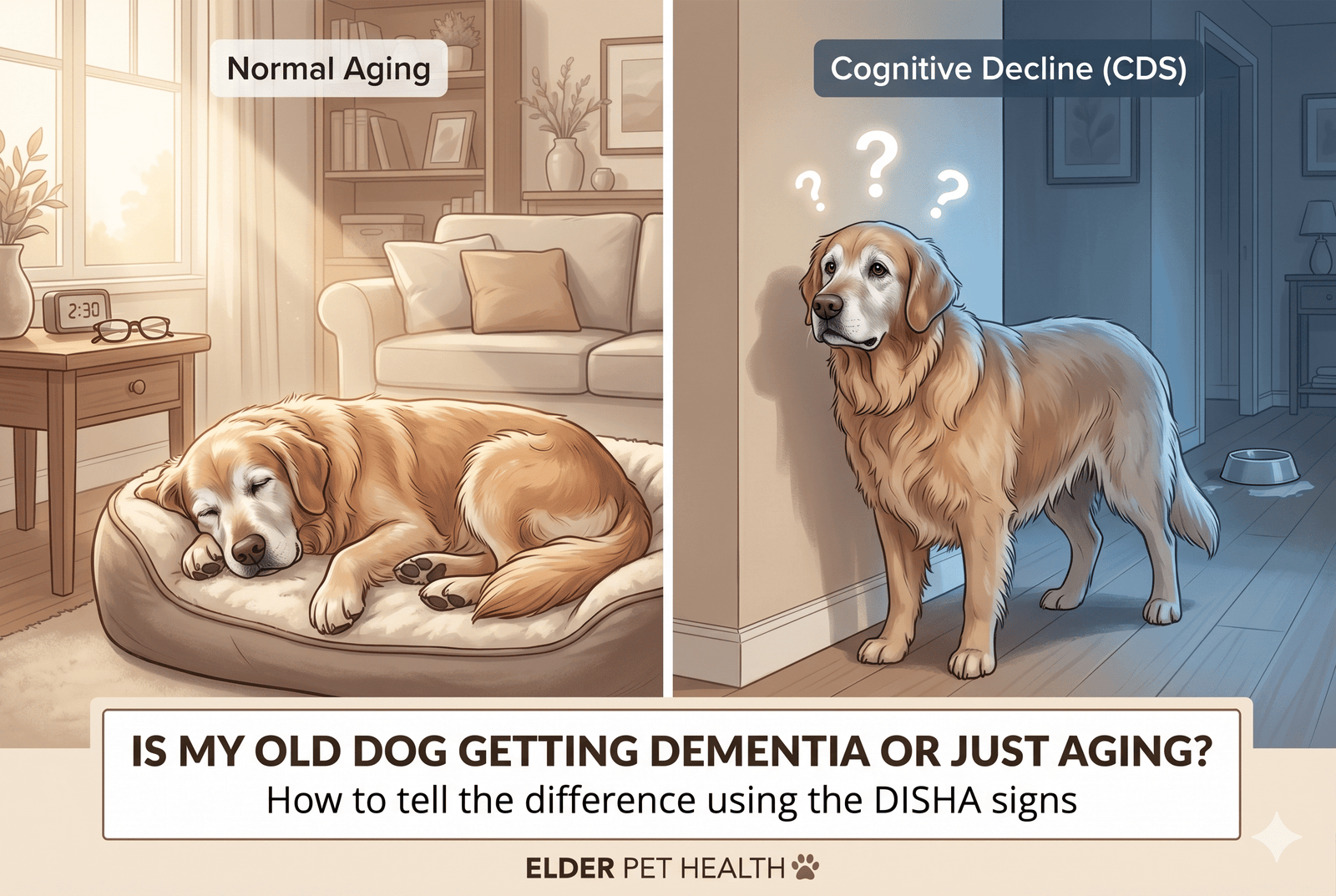
You wonder if he is losing his mind, or if this is just what getting old looks like. The answer matters because canine cognitive dysfunction is a real, diagnosable condition with management options , and it is different from normal aging in ways you can actually observe at home.
The Key Distinctions
- Disorientation: Getting stuck in corners, staring at walls, getting lost , CDS. Not normal aging.
- Sleep reversal: Up at night, sleeping all day , CDS. Not normal aging.
- House training failure: Forgetting bathroom training , CDS. Not normal aging.
- Personality change: Less interactive, more anxious, or unusually clingy , CDS. Not normal aging.
- Reduced activity: General slowing down, tiring earlier , could be either. Context matters.
The DISHA Signs of Canine Cognitive Dysfunction
Vets use the DISHA framework to identify the specific signs that distinguish CDS from normal aging.
D , Disorientation: Getting stuck in corners or behind furniture, staring at walls or floors for extended periods, appearing lost in familiar rooms, walking into rooms and seeming unsure why, not recognising familiar people or pets occasionally.
I , Interaction changes: Less interested in greeting family members, reduced play initiation, more irritable or anxious around people and other pets, or conversely becoming unusually clingy and following you everywhere.
S , Sleep changes: Awake and restless or vocalising at night, sleeping more during the day, reversed sleep cycle. This night-time disturbance is one of the most disruptive signs for families and one of the most specific markers of CDS.
H , House training failure: Urinating or defecating inside despite being reliably trained for years, seeming unaware that they have soiled, going to the wrong spot or not signalling to go outside.
A , Activity changes: Less interest in play and exploration, staring into space, repetitive movements like pacing or circling, reduced responsiveness to commands they previously knew well.
A study found that when vets specifically asked owners about each DISHA sign, 75% reported at least one sign in their senior dog. When owners were simply asked “is your dog showing any behavioural changes?”, far fewer volunteered the same information. The lesson is that owners normalise CDS signs as aging, and specific screening questions reveal what open-ended questions miss.
What Normal Aging Looks Like Instead
A normally aging dog reduces in energy and stamina. He naps more, plays less, tires on longer walks. His senses dull slightly. He may not hear you call from another room as well as he did at 5. His coat changes texture or thins. He may have grey on his muzzle and face.
What a normally aging dog does not do is get confused in his own home. He does not forget that the garden is where he toilets. He does not stare at walls for minutes at a time. He does not bark at nothing in the middle of the night. He does not fail to recognise family members.
Home Observation Checklist
What You Can Do to Help
There is no cure for CDS. But there are meaningful management options that can slow progression and reduce the distress your dog experiences.
Selegiline (Anipryl)
The only FDA-approved medication for canine cognitive dysfunction. Works on dopamine pathways in the brain. Helps some dogs significantly, with modest results in others.
Omega-3 fatty acids
EPA and DHA support brain cell membrane health. Some evidence shows slower cognitive decline in dogs on therapeutic doses. Also beneficial for joint health in older dogs.
Night lights
Dogs with CDS disorientation use visual cues heavily. Night lights in key rooms reduce night-time confusion and the distress vocalisation that disrupts sleep for everyone.
Strict routine
Feeding, walking, and sleeping at the same times every day reduces anxiety in a dog whose brain processes new information poorly. Predictability is a genuine comfort.
Begin active observation from age 9 to 10. Signs can appear earlier in some breeds, particularly those with genetic predispositions. Using the DISHA checklist annually from age 9 gives you a personal baseline. Changes that appear gradual are easier to track when you have a record of what was normal a year ago compared to what you are seeing now.
Yes, and this is exactly why CDS is a diagnosis of exclusion. Chronic pain from arthritis can cause night-time restlessness, reduced interaction, and changes in movement. Anxiety can cause repetitive behaviours. Hearing loss can make a dog appear disoriented when he is simply not hearing cues. Your vet needs to systematically rule these out before concluding that the signs are CDS rather than another treatable condition.
It is a progressive condition, meaning it gets worse over time rather than improving. The rate varies considerably between individual dogs. Some dogs show mild signs for years before significant decline. Others deteriorate more quickly. Early intervention with medications, supplements, and environmental adaptations is associated with slower progression in most dogs.
The Bottom Line
If your senior dog is getting confused in familiar places, disrupting sleep at night, forgetting house training, or showing personality changes, these are not normal parts of aging. They are specific signs of canine cognitive dysfunction that deserve veterinary attention.
Track the DISHA signs over two weeks. Film any clear episodes. Then book a vet appointment and ask specifically about cognitive dysfunction screening. Early diagnosis means earlier management, which means better quality of life for longer.